
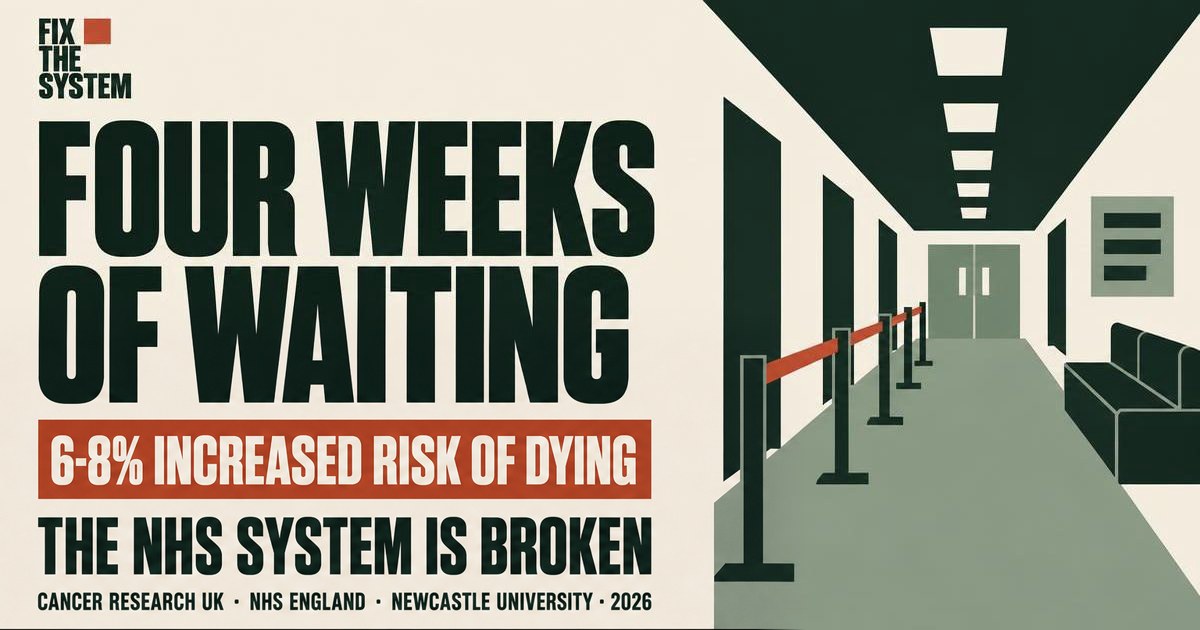
Four Weeks of Waiting. A 6-8% Increased Risk of Dying. How Did the NHS System Get Here?
By Becky Hirst · 19 September 2026 · 18 min read
I'm writing this from two places at once.
One is Australia, where two years ago I was diagnosed with breast cancer. I still remember the afternoon my GP said the words. It lands differently than you expect. Heavier. More real. And then you have to move. You have to enter the system and let it carry you through what comes next.
I went through surgery, radiation, medical oncology, ongoing hormone therapy. The system held me. There was a breast cancer unit that became my place in the system. A team under the leadership of a surgeon, and depending on what I needed, I saw the surgeon, her registrar, a breast care nurse. But there was a real sense that they were coordinating it all, that this was my team, and that they were holding the threads. I moved through different departments, but I never felt like I'd disappeared. I could see what was coming next.
The other place I'm writing from is the UK. It's where I was born. It's where I visit regularly, where I'll be for Christmas. And it's where, right now, a close family member is facing a serious diagnosis. And I'm watching them move through a healthcare system that feels, increasingly, designed to exhaust them before it helps them.
I need to talk about what I'm seeing. Because it's breaking my heart.
The Institution We're About to Lose
The NHS is an absolute institution. It's an asset beyond measure. When it was created, it was genuinely visionary. Free at point of care. Based on need, not ability to pay. My parents have paid their taxes their entire lives, and the idea was always that the NHS would be there for them when they needed it. That's a profound commitment.
The problem isn't the commitment. The problem isn't the professionals. The GPs are excellent. The registrars are competent. The consultants are skilled. I've watched my own family interact with dedicated people trying their best.
The problem is the system those people are trying to work within. And right now, that system is breaking under its own weight.
The System As Experienced By One Person
My family member was referred through the urgent suspected-cancer pathway. Their GP was brilliant. Really genuinely brilliant. Supportive. Clear. Fighting for them, pulling strings to bring the initial hospital appointment forward by a week. This is someone who understood that time matters when you're frightened.
They were seen by a registrar who confirmed what needed to happen next. A specialist endoscopic ultrasound and biopsy to establish whether what they'd found was cancerous.
Then came the waiting. And the maze.
The procedure they needed required an appointment from a consultant who allocates the slots. The booking team couldn't say when that would happen. There were six people ahead of them. The wait might be another three weeks.
I want to be really clear about what that means, because I think we sometimes sanitise this with language like "waiting list" and forget what it actually feels like to live it.
Someone facing a potentially life-changing diagnosis was now responsible for chasing referrals. For discovering where they'd landed in an unseen queue. For figuring out who had the authority to move them forward. For trying to understand when they might finally get the answers they needed to know if they were going to die.
They couldn't plan. They couldn't process. They couldn't think past the next phone call they'd have to make. They could only wait and wonder and worry.
I watched them trying to hold it together. Trying to go about their day. Trying not to spiral into the worst-case scenarios that filled the space between appointments.
The uncertainty wasn't medical. The doctors knew what needed to happen. The uncertainty was administrative. It was bureaucratic. It was the system itself.
And as the days stretched out, my family began researching private options. Because the psychological distress of not knowing, of being stuck in a system designed to move slowly, of having no visibility into when your turn might come, felt unbearable. They discovered these procedures could cost thousands of pounds. Thousands to skip ahead. Thousands to get answers faster. Thousands in a system that was supposed to be free at point of care.
That's when you realise the system has a cost. It's just not always paid in money.
Nearly four weeks after the original referral, the procedure finally happened. Four weeks of not knowing. Four weeks of fear. Four weeks of being responsible for managing their own care because the system wasn't managing it for them.
The consultant was excellent. Clear. Explained what they'd found. Discussed possibilities. Spoke about referrals to specialist centres. But my family member was exhausted by then. Wrung out. The fear had been replaced by a kind of hollow tiredness. And now they're waiting again. For pathology results. For a definitive diagnosis. For the next step. For the system to move.
That's what it feels like to move through a healthcare system organised around departments, processes, referrals and waiting lists. You don't experience it as a system. You experience it as one continuous, terrifying event.
One thing that should connect logically feels fragmented across multiple points of contact, each with its own waiting time, its own queue, its own point where you might disappear.
Each handoff between departments is a small death. Did they get the referral? Are you in the right queue? Who do you call if you're not?
That's not healthcare. That's a person trying to survive an ordeal while the system that's supposed to help them makes them do the work of holding it all together.
The Numbers Behind the Story
My family member's experience isn't unusual. It's becoming the norm.
In July 2026, only 71.2% of patients in England started their first cancer treatment within the 62-day target from urgent referral. The target is 85%. That target has not been met since December 2015. Nearly 4,400 additional patients in that month alone would have been treated on time if the system had met its own standard.
In the same month, 79.3% of people were told whether they had cancer within the 28-day target. That means roughly one in five waited longer. About 2,100 additional patients would have received a diagnosis or had cancer ruled out on time if the system had met its 80% standard. The underlying NHS England cancer waiting-times statistics are published monthly and remain provisional before final revision.
The frightening part is what delay can mean clinically. A major peer-reviewed analysis of treatment delay and mortality found that, for certain cancer surgeries, every four-week delay was associated with a 6 to 8 percent relative increase in the risk of death. The figure does not apply equally to every cancer or every treatment. But it makes one thing plain: waiting isn't only psychologically brutal. For some patients, it can change outcomes.
My mum tells me she makes a phone call to the local GP practice and gets put on hold. Sometimes she waits for hours, with hundreds of people in front of her in the queue because the hold message tells her this. By the time she gets through, she's exhausted. And there's still no guarantee she'll have any continuity of care.
They paid their taxes. Every year, for decades. The deal was simple: you pay in, and when you need care, it's there. Not perfect care, but care. Equitable care. Based on need, not ability to pay. That was the promise of the NHS.
What they've got now is an NHS that requires them to become their own project managers just to access it. To chase appointments. To figure out who to contact when things stall. To advocate for themselves constantly, when they should be able to trust that the system is advocating for them.
When my mum tells me about these phone calls, I feel something shift in me. This is someone who should be able to rest on what she's paid for. Instead, she's exhausted from trying to access it.
Why This Is Happening
The NHS wasn't always like this. Waiting times were falling during the 2000s and the service was moving in the right direction. Since then, years of constrained funding, repeated restructures and growing demand have placed the system under sustained pressure.
But money is only part of it, though money matters. It's also about how the system is organised. Newcastle University research found that as private provision expanded after 2008, NHS capacity fell and waiting times for hip and knee replacements increased, with the longest waits falling on the most deprived patients. This is not simply a story about one budget line. It is a story about what happens when policy changes alter the shape and capacity of the system itself.
There's also a massive administrative burden. People are drowning in bureaucracy. In one Royal Free London blood-cancer pathway, a detailed review identified around 111 hours of avoidable administrative and coordination work every week. That is one trust, not a national total, but it shows how much frontline time can be absorbed by managing the system itself rather than caring for patients.
So your GP is excellent but exhausted, fighting through layers of referral processes and approval chains to get you care. Your family member gets an appointment, but then has to move through multiple departments, each with its own waiting list, its own queue, its own administrative requirements.
The system wasn't designed this way on purpose. But it evolved this way over time. Budget constraints. Restructures. Layers of regulation. Each one adding friction.
And somewhere in that friction, the patient disappeared.
What I Learned From A Different System
When I was diagnosed with cancer in Australia, I moved through a different system. The culture here is different around private healthcare. More people have it than anywhere I've experienced. And I do. But when it comes to public healthcare, and I was able to access that for much of my treatment, the design is different. The process is different.
I had a breast cancer unit that held responsibility for my care across departments and appointments and decisions. It was a team, not a person. Depending on what I needed, I saw the surgeon, her registrar, or a breast care nurse. But there was clarity about who was coordinating. Someone understood that I needed to know what was happening next. The team connected the dots so I didn't have to carry all the anxiety of not knowing.
I remember the first time they said to me, "Here's what happens next. Here's when you'll hear from us. Here's what to watch for." And I felt something loosen in my chest. Not the fear of the diagnosis. That didn't go away. But the fear of falling into a void. That shifted.
That's a design choice. That's a system saying the patient's experience of continuity matters. Moving between departments shouldn't feel like falling into a void. We're going to design for the person, not just for process efficiency.
Now, I want to be really honest here. The Australian system has serious problems. It absolutely does. It costs money to access, which is a huge inequity. Healthcare is fragmented across public and private in ways that leave real gaps. It's not perfect. I never want to suggest that Australia has figured it out, because we haven't.
But in my case, in my experience, it was designed to move me towards health. Not to process me through departments. There was someone whose job was to make sure I didn't disappear.
And I didn't.
Now I'm watching my family member in the UK system, and they're disappearing. Into queues. Into administrative gaps. Into a waiting game that nobody designed on purpose, but that nobody seems to know how to fix either.
What The System Is Actually Broken At Doing
Here's what I've come to understand after close to thirty years of consulting work, watching organisations break under their own weight. When a system fails, it's almost never because the people in it are failing.
My family member's GP didn't fail. Far from it. The registrar didn't fail. The consultant didn't fail. Each person did their job competently. Some of them did it excellently. They showed care. They showed skill. They showed genuine concern.
The system failed because it was designed around processes, not people. Deliberately or not, it doesn't matter. Around departments. Around throughput. Around efficiency metrics that nobody remembers why they were put in place in the first place.
It optimised for scheduling efficiency and departmental capacity. It didn't optimise for the human experience of moving through it while you're terrified. It didn't optimise for continuity. It didn't optimise for someone being able to know what's coming next.
And so what happened is this. The system created a situation where patients must become their own project managers. Where they must chase referrals. Where they must figure out who has authority. Where they must advocate constantly for themselves. Where uncertainty is administrative, not just medical.
The system itself becomes another burden. On top of the fear. On top of the diagnosis. On top of the grief.
I think about my family member exhausted after four weeks of waiting, and I think this isn't what the NHS was meant to do. This isn't even what it's trying to do. But this is what's happening because somewhere along the way, the system stopped being designed for people and started being designed for throughput.
The NHS isn't broken because professionals don't care. It's broken because the system they're working within wasn't designed to care for the person, only to process the case.
What It Would Take To Fix It
At FTS, Karen and I work differently than most consultants. We don't come in with a deck full of solutions. We come in to listen. Really listen.
And I think the NHS needs that desperately. Not because it needs someone to come in and tell it how to fix itself. But because it needs someone to help it listen to itself. To the people inside it. To the people moving through it.
We would start at the very top of healthcare decision-making. Not in individual practices or trusts, but in the rooms where the big design decisions are actually made. And we would do something that honestly doesn't happen enough in those rooms: we would bring three groups into genuine conversation.
The decision-makers. The professionals on the frontline. The patients living the experience.
I would sit down with the decision-makers and ask how are you designing care. What outcomes are you optimising for. What were you optimising for when you put this in place. Is that still what you want to optimise for now. And I would ask them to listen. Really listen. To the nurses, the doctors, the GPs in the system saying that it's breaking them too. That they want to care for patients holistically but the system makes that nearly impossible. That they're watching my family member suffer through waiting and they can't fix it without changing the system itself.
And I would ask patients: what does it feel like to move through this? Where does the system lose you? Where do you get confused, frightened, abandoned? When did you feel like a person being cared for, and when did you feel like a number being processed? What would it look like if we designed this for you, not for throughput?
And then we would actually pay attention to what we heard. Here's the important bit. We wouldn't come back with a training program or a new protocol or another initiative. Using our EVA model, we would come back asking what are we optimising the system for. Is it still the right thing. Is it still serving the purpose the NHS was created to serve.
Because here's what I believe. The NHS was created on a radical principle. That healthcare is a public good. That a nation should care for its people equitably. That's still a radical principle. That's still the right thing to optimise for.
But the system that was built to deliver that has been stress-tested beyond its design capacity. It's fragmented across too many departments. It's organised around processes that were designed for a different time, in different conditions, with different expectations. It's waiting longer than it's meant to. And the humans moving through it, both the professionals and the patients, are suffering.
This isn't a problem that more money alone will solve. Money helps. Absolutely, genuinely, it helps. But I watched an Australian health system with different funding manage better because it was designed differently. With intention. With someone whose job was to hold the thread.
This is a problem that redesign can solve. Starting from the top. Starting with the question: what are we actually trying to do here? And are we still doing it? Starting with listening.
That's what I know how to do. That's what I've spent close to thirty years learning to do.
To The Patients Reading This
If you're moving through a healthcare system right now. If you're waiting. If you're scared. If you're making phone calls trying to figure out who to call next. If you're wondering whether the exhaustion you feel is reasonable or whether you're supposed to just cope with it.
I want you to know something: you're not crazy. You're not being difficult. You're not asking for too much.
The system shouldn't require you to be your own project manager just to access the care you need. You shouldn't have to chase referrals or figure out who has authority or advocate relentlessly for yourself while you're terrified. That's not how healthcare is supposed to work. That's not what the NHS was meant to do.
The exhaustion is real. The confusion is real. The uncertainty is real. And it's not because you're not resilient enough or strong enough or good enough at navigating systems. It's because the system isn't designed for people. It's designed for throughput. And that's not your failure. That's a system failure.
Some of you reading this might be thinking well, what am I supposed to do about it. I'm just trying to survive this. And you're right. Right now, you survive it. You do what you have to do. You chase the phone calls. You hold yourself together. You get through.
But I also want you to know that you matter in this conversation about how things change. Your experience. Your frustration, your fear, your exhaustion. That's not anecdotal. That's data. That's information about how the system is actually working. And when people in power start listening to what that feels like, that's when things shift.
To The Decision-Makers Reading This
If you're a decision-maker in healthcare. If you're someone in a position to influence how the NHS is structured, how care pathways are designed, how resources are allocated. If you're sitting in a meeting about waiting times and targets and wondering why nothing seems to shift. If you're tired of missing targets. If you're watching people suffer through waiting and you feel powerless to fix it.
I want you to know something. The problem you're trying to solve is real. The system is broken. But the people telling you it's broken. The GPs, the registrars, the consultants, the patients. They already know that. They live it every day.
What they don't know is how to fix it. Because the solution isn't a bigger sticking plaster. It's not another initiative. It's not more protocols or more efficiency training.
What if you had a conversation with the people closest to it? Not a survey. Not a consultation. Not a working group where people present data and nod professionally and go back to their departments. What if you actually listened? What if you asked them to help you understand what's broken and why, not just what's broken and how do we patch it faster?
What if you asked your frontline professionals what they need in order to care for people the way they went into medicine to care for them? What if you asked patients what it would look like if the system was designed with them in mind, not around them?
That's where real change starts. I've seen it happen. Not fast. But real.
We work with organisations everywhere. We start by listening. We ask what's actually blocking people. We investigate what's already in place and whether it's still fit for purpose. We bring different groups into genuine conversation. Through our work with organisations, we help you fix the real problem, not the symptom. Our case studies show what that looks like in practice.
The NHS is an institution built on care. On the radical idea that healthcare is a public good. But right now, the system is making it nearly impossible to deliver that care equitably, efficiently, humanely. That can change. It won't happen overnight. But it can change if you're willing to ask deeper questions. If you're willing to listen.
If You Want To Talk About Change
Whether you're a patient moving through this system or a decision-maker trying to redesign it. If you want to have that conversation, you know how to reach me.
For patients. If you want to be part of how we talk about what needs to change, if you want your experience heard, let's talk. Your story matters.
For organisations. If you want to start exploring what real change would actually look like for your healthcare system, not what looks good in a report but what actually works for the people inside it, let's talk.
We start by listening.
And from there, I genuinely believe, anything is possible.