
Burnout Is Costing Singapore S$95 Billion a Year. Here's What That Means for Your Business.
By Becky Hirst · 17 September 2026 · 8 min read
I was in Singapore a few weeks ago and I'll be back there at Christmas. It's one of those places that Karen and I pass through on our way from Australia to the UK, one of the waypoints on the channel we're building FTS through. And while I was there, I kept noticing something I've felt everywhere else I've worked: that particular quality to a workplace where you know something isn't right but nobody seems to be saying it out loud.
You know this feeling, right? A workplace that just doesn't feel right. A workplace you struggle to bond with, where the effort it takes to move through the day feels disproportionate to what you're actually doing. Where the systems feel like they're working against you rather than for you.
I remember this from my early career, before I started consulting. Before Becky Hirst Consulting, before HeyEngage, before working with Karen on FTS. I spent years in environments where I was managing so many layers of approval chains and paperwork that my creative ideas just died. I'd have something to contribute, something different because my brain works differently, and then I'd hit a system that wasn't designed for how I think or work, and the energy it took to move through that system meant I had nothing left for the ideas themselves. I'd feel frustrated and a bit stuck. I thought the frustration was my problem to solve. I thought I wasn't adapting well enough.
It never occurred to me that the system might be the issue, not me.
Now, after seventeen years of consulting work through my various practices, I see organisations doing something similar. I watched one workplace add a bowl of fruit in the shared kitchen. Genuinely well-intentioned. A lovely gesture. But a bowl of fruit doesn't tackle why staff are depleted. It doesn't address why people feel a lack of meaning or autonomy or fairness. It's like putting a plaster on a much deeper wound. The fruit is good. The fruit is a nice thing. But the fruit isn't the solution to the problem.
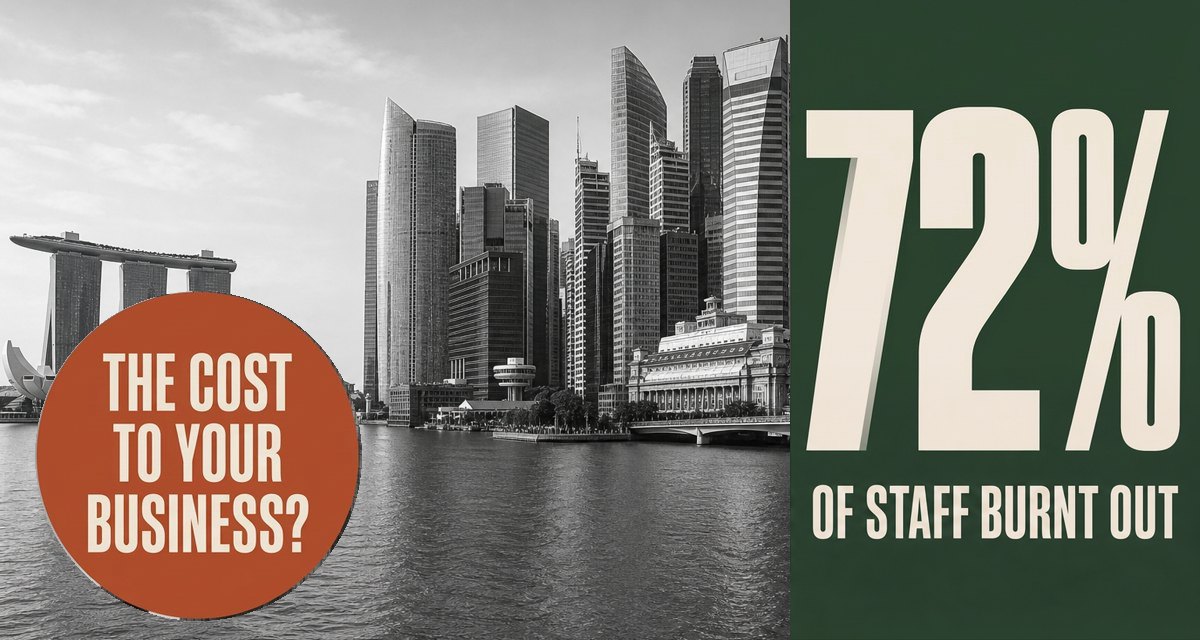
Here's what I found when I looked at what's happening in Singapore right now. A new report from Jobstreet by SEEK found that only 56% of Singaporean workers are happy at work. That puts Singapore near the bottom of Asia-Pacific workplace happiness rankings, just above Hong Kong. Jobstreet's own research found that 45% feel burnt out or exhausted. Separate research shows the scale from other angles: Employment Hero reported 61% experiencing burnout, ManpowerGroup found that 72% had recently experienced burnout, and Singapore's Ministry of Manpower found about one in three voluntary iWorkHealth participants experienced work-related stress or burnout. Different studies use different samples and measures, but the pattern is consistent. People are struggling, exhausted and overwhelmed.
The standard response is familiar: wellness days, gym memberships, mental health apps and another bowl of fruit in the kitchen. These are good things to offer. Nobody's arguing against them. But here's what's actually happening. Organisations are doubling down on these initiatives while the system that's actually breaking people stays completely unchanged.
But there's something important that the wellness budget never shows you. This is not a happiness problem. It is a balance-sheet problem. In June, the Singapore Institute of Directors and Gallup released the Singapore Workplace Report 2026, and they put a number on what disengagement costs: only 14% of Singapore employees were engaged at work in 2025, and that disengagement costs the economy an estimated S$95 billion in lost productivity every year. Separate research from TELUS Health found Singapore employers lose up to 65 working days per person each year where workplace support for mental health falls short. And research published in the American Journal of Preventive Medicine puts the burnout bill for an average 1,000-person company at more than US$5 million a year. Burnout is not a mood. It is a line item, and most organisations have never audited it.
An employee is burnt out because they're trying to get an approval from someone five levels above them in a hierarchy that wasn't designed for speed. They're burnt out because a simple decision requires three different departments who don't talk to each other to align. They're burnt out because the system treats them as replaceable, so there's constant job insecurity. They're burnt out because the expectation of long hours is unstated but absolutely clear, and it's coded into how you get promoted, how you're valued, whether you're seen as committed or not.
So you add a mindfulness app and a bowl of fruit and a flexible working policy. And they take the mindfulness app and they enjoy the fruit and they try to work flexibly and then they go back to moving through a system that wasn’t designed with them in mind.
The wellness program doesn't change the approval chains. It doesn't flatten the hierarchy. It doesn't make the system move faster or more fairly. It doesn't address why the system is structured to exhaust them in the first place. It just gives them new coping mechanisms while the real problem stays completely invisible.
This is what we see everywhere. Not just in Singapore, but in Bangkok and Toronto and Sydney and London and Kuala Lumpur. Burnout doesn't respect borders. The systems that create it look different on the surface but they're built on the same foundation: they were designed for a person who doesn't exist anymore, if they ever did at all. A person who works nine to five in the office. A person who fits into standard workflows. A person whose brain processes information in the standard way.
The people trying to move through these systems now don’t fit that template.
The system is working perfectly for whoever designed it. It’s just not working for the people actually trying to move through it.
And that’s not an accident. Economic historians have traced this template straight back to the factory floor. Before the Industrial Revolution, most workers controlled their own pace, their own timing and how they went about their work, and factory discipline replaced all of that with the clock, the shift and the standard worker. The approval chains and the nine-to-five defaults inside your organisation are that factory logic, two centuries on, still running.
I think about my early self, frustrated and believing the frustration was my failure. And I think about all the Singaporean workers, all the burnt-out employees everywhere trying to meditate their way through a system that exhausts them by design. I think about the creative ideas that die because the system is so heavy that there's no energy left for them. I think about the neurodivergent people, the people who work differently, the people who bring different thinking to problems, getting ground down by approval processes that were designed for efficiency, not for ideas.
This is what we do at Fix the System. We don't come in and tell you your people need to be more resilient or less sensitive or better at boundaries. Using our EVA model, we listen to the people inside the system and we ask them what's actually blocking them. We look at what you've built, what's already there, and we ask whether it's designed for the people you have now or for people from twenty years ago. We validate it with the people living it and we validate it with you and we find the actual cause, not the symptom.
So when I look at that Jobstreet report, when I see that only 56% of Singaporean workers are happy, when I see separate research reporting 72% experiencing burnout despite all the wellness initiatives, what I'm reading is not a people problem. I'm reading a system problem. I'm reading what it looks like when organisations are trying to help people cope with systems that shouldn't exist in the first place.
The question isn’t how do we make people happier within the system. The question is whether the system is actually serving the people inside it.
If your organisation recognises itself in this story, if you're seeing burnout despite your wellbeing programs, if you're hearing people say they need flexibility while the system makes flexibility nearly impossible, then maybe you need to start asking the same questions we explored in our other post about Adelaide's homelessness crisis. Maybe you need to stop treating the symptom and start looking at the system.
We work with organisations all over the world. Singapore. Australia. The UK. Canada. Bangkok. Anywhere humans are trying to move through systems that weren't designed for them. The pattern is the same everywhere. The solutions are different for each place and each organisation because they have to be. But the diagnostic process is always the same.
We listen. We investigate. We validate. We find the real problem.
That's where we start the conversation.