
Fix The System · fixthesystem.world
SA's Ramping Crisis Isn't About Ambulances
By Becky Hirst · 6 October 2026 · 5 min read
Last month, an independent review of SA Health concluded it was "unreasonable to think" ambulance ramping could ever be "fixed", although it said bringing it below 2,000 hours a month would mean it was at least "under control". Around the same time, data tabled in state parliament showed South Australia spent $123.7 million last financial year caring for older patients who were medically ready to leave hospital but had nowhere to go.
Read those two things side by side. One says the problem can't be fixed. The other tells you exactly where to look.
The obvious answer to ramping is more. More beds, more paramedics, more emergency staff, a bigger hospital. And South Australia has been doing more: more than 700 extra hospital beds delivered since 2022 and more than 4,000 extra frontline healthcare workers. Yet ramping hours have more than tripled since 2019-20, from about 15,000 hours a year to 49,000. August 2026 set a new monthly record of 5,891 hours.
When a system needs record investment just to stand still, the answer usually isn't a bigger version of the same system.
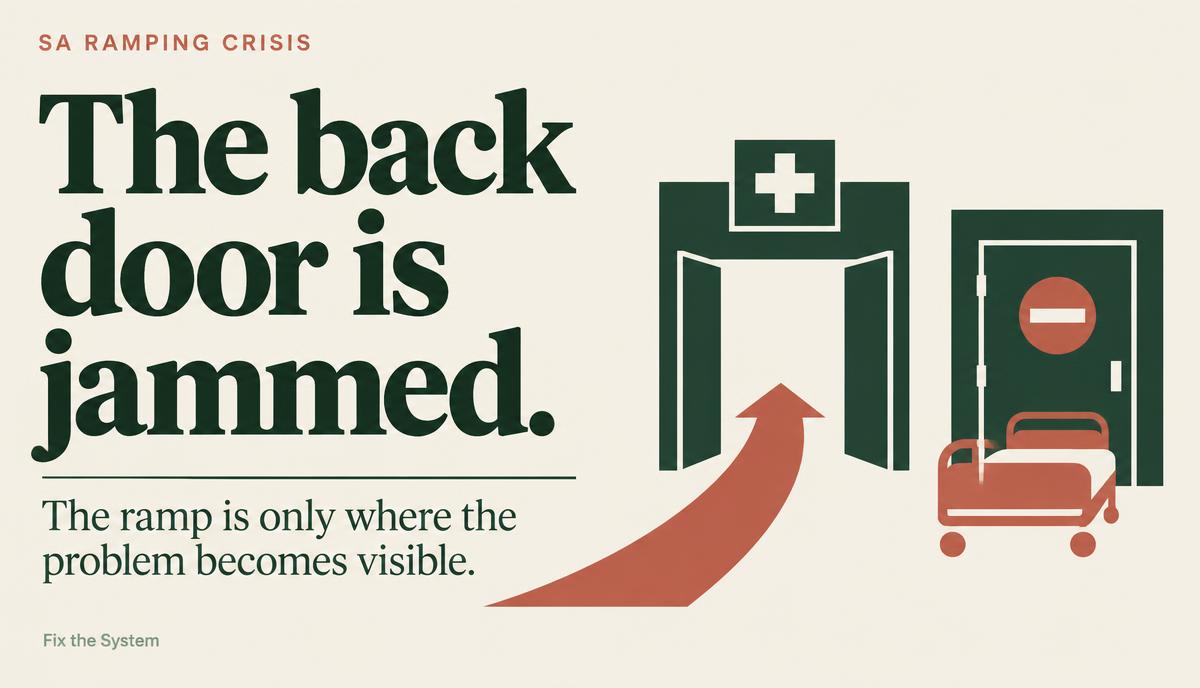
Ramping looks like an ambulance problem because that's where we see it. The line of vehicles outside the emergency department. The paramedic stuck with a patient for hours. But ramping isn't where the problem starts. It's where the problem becomes visible.
Follow one patient through. To get off the ramp, they need a space in ED. To free a space in ED, someone needs a ward bed. To free a ward bed, someone needs to be discharged. In September, 487 older South Australians were stuck in hospital waiting for a residential aged care bed despite being medically ready for discharge. In October 2022, that number was 60.
Each of those patients costs an average of $1,318 a day. AMA SA estimates that one bed occupied for 100 days means 15 to 20 other patients can't access treatment. Some people have been waiting for almost four years.
So the ramp is the front door, and the back door is jammed. No amount of widening the front door helps when nobody can leave through the back.
The failure isn't inside any one part. It's in the join between them, and nobody owns the join.
This is the part that fascinates me. Every piece of this chain has an owner. The ambulance service owns the ambulances. The state runs the public hospitals. Aged care providers deliver residential care, within a system primarily funded and regulated by the Commonwealth. The state says aged care is a federal responsibility. The federal government describes the challenge as shared.
Each of them can be doing their job well, and the system can still fail. Because the failure isn't inside any one part. It's in the join between them, and nobody owns the join.
That isn't a criticism of the paramedics, nurses, doctors, aged care workers or even the ministers. Most of them are working incredibly hard inside a design that no longer fits. As Karen puts it, absurd is expensive. $123.7 million is what absurd cost South Australia in one year, before you count the paramedics on the ramp, the clinicians burning out and the families sitting in limbo.
Here's where it gets closer to home, because this happens inside organisations all the time. A council's customer service team gets complaints about wait times, so it hires more staff. Wait times barely move, because the real delay is an approval sitting in another department. A team is burning out, so leadership adds a wellbeing program, but the workload comes from a process nobody is allowed to question.
The symptom shows up at the front door. The cause sits somewhere else, usually in the gap between two teams who each think it's the other's problem. Treat only the front door, and you spend more and more just to stay in the same place.
This is the work we do at FTS. Using our EVA model, we engage on the symptom, the queue or the complaint or the burnout, to open up the conversation. We validate what we hear with the people living it and the leaders responsible for it, until we find the cause. Then we adapt the system to fit the people it's meant to serve. I work outside in, with the customers, communities and families a system touches. Karen works inside out, with the leaders and teams running it. You need both lenses to see the join.
So when a review says it's unreasonable to think ramping can ever be "fixed", while setting a target for getting it "under control", I'd gently push the thinking one step further. It's unreasonable to think ramping can be brought under control by looking only at the ramp.
The question isn't how to make the front door bigger. It's where the system is actually stuck, who owns that point, and what it would take to unstick it.
If your organisation keeps spending more on a problem that keeps getting worse, that's the question we'd start with too.