
Fix The System · fixthesystem.world
Your data is clean. Your system is absurd.
By Karen Cocks · 9 October 2026 · 8 min read
Eight contacts, zero help
Six weeks ago, my daughter, a learner driver, misjudged a car park and scratched the side panels of my car. I did what you do: rang the insurer, lodged the claim, paid the excess and waited to be told where to take the car.
Since then, my insurer has contacted me eight times. Four calls, four emails, all chasing the excess I’d already paid.
Not one told me where to take the car.
I’ve spent weeks in their portal trying to work out whether I really need to drive 250 kilometres to have someone look at a scratch. I still don’t know what happens next, whether there’s another option, or when anyone will assess the claim. And the excess reminders keep coming.
Inside the insurer, my claim probably looks fine. Eight successful outbound contacts. Customer engaged. Excess outstanding. Within service levels. Every field filled, every timestamp accurate. Clean data, telling exactly the wrong story.
The payments system is beautifully connected to outbound contact. It knows I owe money, and tells me often. The claims system, assessment network and portal don’t seem to talk to each other at all.
The only thing joining them up is me.
The new garbage in
When customer experience was a young discipline, we couldn’t stop talking about data quality. Duplicate records. Missing fields. Garbage in, garbage out. I said it myself, in more boardrooms than I can count.
We mostly fixed that. But a new data quality problem has replaced it, and it’s harder to spot because it doesn’t look like garbage. It’s the absurdity in your current system.
Your data records the service you designed, not the one your customers live through. The customer experience map, the process documentation, the survey you chose to send: all stand-ins for reality, written by the people who built the system, in the system’s own language.
And the absurdity nearly always sits in the same place: the integration layer.
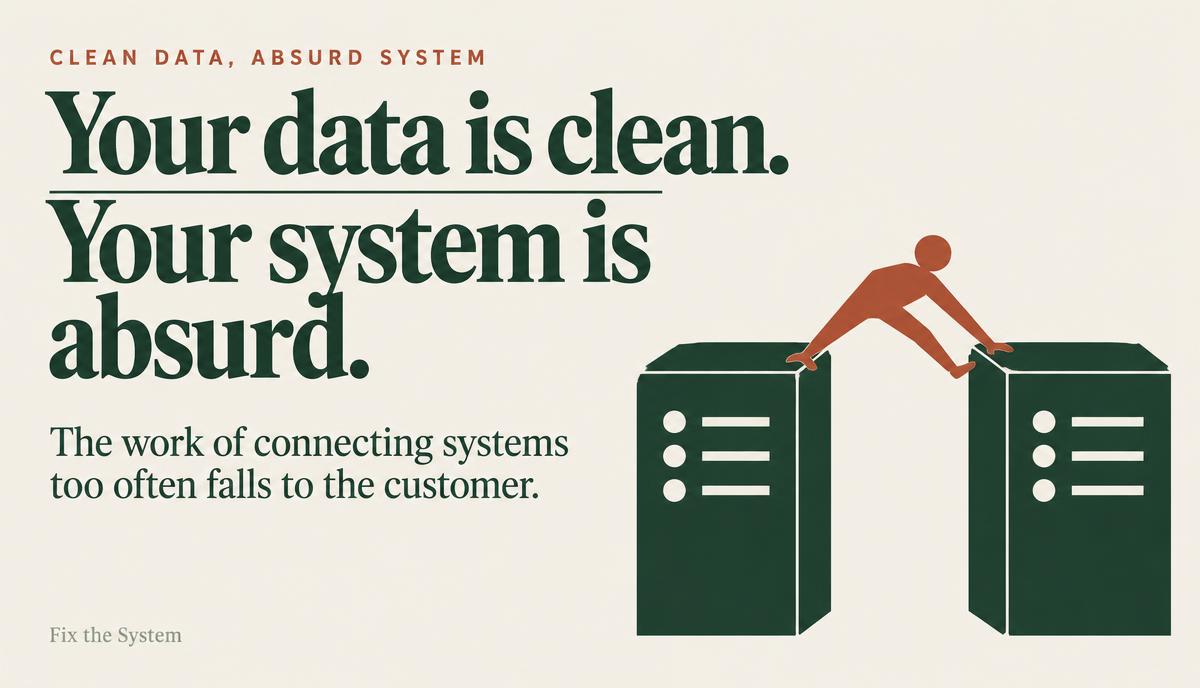
In technology, the integration layer is the middleware that lets separate systems share information. In most organisations, the real integration layer isn’t software. It’s the customer.
When your systems don’t talk to each other, your customer talks for them. They carry information between departments, re-explain their situation to every new person, and upload the same document twice because the second team can’t see the first. They chase, keep notes and work out which system needs what. They become the human middleware.
None of that work is recorded. Each system holds clean, accurate data about its own small part of the experience. The joins between them, where the absurdity lives, happen in the customer’s head, on their phone and at their kitchen table.
Why can’t they just start with yes?
I’m not just the CX person. I’m someone with a story, and I can’t unsee the absurdity in the systems we’ve built.
I’m in my second year back at work after what my business partner Becky Hirst and I fondly call my big burnout. And it was big.
I won’t pretend systems caused it. Life did plenty of that on its own. But I know exactly what kept me under, because I spent months filling it in, uploading it, re-explaining it and waiting on hold for it.
Managing my own health and caring for my critically ill daughter, I ended up on the floor, completely overwhelmed, asking one question: why can’t they just start with yes?
I was squeezing my daughter’s very serious health needs into forms and systems that supposedly existed for families exactly like ours. Failure point after failure point. I told our story again and again to departments, agencies and providers that couldn’t see what the others already knew. Without realising it, I had become the integration layer for a system meant to support us.
Every form had a reason. Every eligibility rule made sense to someone, once. Every handover was a sensible decision by a reasonable person. But stack enough sensible decisions together and you get something absurd. That’s how it builds: one reasonable decision at a time, until the person the system is meant to serve ends up doing all the work.
I’d spent thirty years leading transformation and customer experience programs, designing operating models, sitting in the rooms where these decisions get made. It took sitting on that floor, on the other side of the counter, to see what it all looked like from there. I had become the middleware.
Once you’ve seen it, you notice it everywhere.
Who can’t do this work?
Being the integration layer takes time, energy, confidence and, increasingly, digital skills. Plenty of people don’t have all four.
Around one in five Australians is digitally excluded or highly excluded, according to the 2025 Australian Digital Inclusion Index. Exclusion is highest among people aged 75 and over, the lowest-income households and First Nations people.
Almost three quarters of people with disability don’t feel comfortable keeping up with changes in technology (Australian Digital Inclusion Alliance, 2025).
These are often the people our services exist to support, and the least able to do the integration work our systems hand them.
Having a bank account is no longer optional if you want to function in modern society. Digital banking cannot be treated as equally accessible to everyone.
Now look at what organisations count instead. In banking, where I spent most of my career, 99.3% of customer interactions now happen through digital channels (Australian Banking Association, 2025).
I know how good that looks in a board pack.
But it only counts interactions that happened. Not the person who gave up halfway through the app, rang their daughter to do it for them, or never tried. If someone can’t do that work, the data simply misses them.
That’s the data quality problem in a single statistic. The data is accurate. It just measures the people your system already works for.
Why your usual tools miss it
The integration work we’ve pushed onto customers happens between processes. So as far as the process map is concerned, it’s free.
- User acceptance testing checks the system does what we built it to do, not whether what we built makes sense.
- Voice of the Customer surveys only ask the questions we thought to ask, of the people who got far enough to be surveyed.
- Lean and Six Sigma look inward at our steps and our waste, one process or department at a time.
Now add AI
This is where I want to challenge my fellow customer experience professionals.
We’re all talking about AI, automation and fewer touchpoints. But AI learns from the data we give it, and it’s usually deployed one system at a time.
Put it on top of a system where the customer is the integration layer and it won’t fix the absurdity. It will learn it, and speed up the parts already connected.
My insurer’s payments system is already automated. Add AI and I’ll get smarter, better-personalised reminders about an excess I’ve already paid, and still no idea where to take my car.
The customer is still the middleware.
They just have to work faster to keep up.
AI doesn’t know the absurdity is absurd. It thinks it’s the process.
Feed it the service you think exists and you’ll get the same absurdity, faster, cheaper and at scale.
Mystery shopping the join
This is why Becky and I started Fix The System.
Our first offer, Test the System, starts where the customer starts. We come to your system cold, with a real problem to solve, and write down every place it asks us to do work your systems should be doing.
In other words, we collect the data your systems can’t see.
We watch where people get stuck and what they have to repeat, re-explain and re-upload. We map every point where your systems don’t connect and the customer steps in as go-between. Most of all, we watch what happens when they need help.
We use two lenses throughout:
The integration layer. Where is the customer doing the work of connecting your systems, and how much?
Who is being left out. Who can’t do that work at all, because of illness, disability, caring responsibilities, language or time, and what happens to them?
Then we show you what the absurdity costs: staff time, repeat contact, complaints, and the impact on the people you exist to serve.
Test the System is the first step of our EVA method:
Engage with the people you exist to serve and understand what they’re really experiencing.
Validate it, so your organisation believes what it’s seeing.
Adapt the policy, process, culture or point of view that needs to change, then measure the benefit.
Every organisation we’ve looked at has an absurdity stack, and the people inside it are usually as frustrated as their customers. Our job is to turn what people on the other side of the counter already know into something you can act on.
Before you automate it
Before we use AI to make our systems faster, let’s check they work for the people they exist to serve.
Your data might be clean. That doesn’t mean it’s connected. And if your customer is your integration layer, it isn’t telling you the truth.
You don’t need a transformation program to start. Find one place where your customer is the go-between for two of your own systems, and close that gap. If you’re an insurer, I can suggest one.
If you’ve got a story of your own, I want to hear it.
So tell me. What’s your absurdity?