
Fix The System · fixthesystem.world
Parents of 250 South Australian Children Threatened With Prosecution. We Think the Process Is the Problem.
Why a child with a lifelong disability needs “exceptional circumstances” to go to school part time.
By Karen Cocks, Co-founder, FTS. · 20 October 2026 · 8 min read
In October 2026, The Advertiser reported that more than 250 South Australian families were being threatened with prosecution because their kids weren't at school.[1] Every solution in the article, from taskforces to teacher training to better support pathways, is still about getting our kids back to school full time.
The Department said no parents had been prosecuted in the past year. It said the threat of prosecution, combined with offers of support, re-engaged students in more than 80 per cent of cases, and that attendance in South Australian schools is now above the national average.
That gap between what the system is trying to achieve and what families are asking for is exhausting.
Becky and I are both parents of neurodivergent kids. Through our podcast, our work and our own circles, we hear from parents who want their kids to have friends, to feel they belong somewhere, to learn how to be around other people and not feel isolated. Education matters to us. But when school isn't working for a child, our first concern is whether they still have connection, belonging and support.
When the response keeps coming back to getting a child to school full time, those needs haven't been heard. I know that exhaustion. I've had too many moments of locking myself in my bedroom, worn down and asking: why can't they start with yes?
At FTS., we find where a system stops doing what it was set up to do, and we fix it. This article explains how we found the problem here, and what we want to do about it.
How we find the absurd
We use a method called EVA: Engage, Validate, Adapt.
Engage means starting with the people the system exists to serve and following what actually happens to them. For school attendance, that means following the path a family takes from the first sign of trouble. We call this the front door.
Here is that path, step by step.
1. The child. A child is autistic, and a full school day is too much for them. They become distressed, shut down and start missing school.
2. The parent and school meet. The parent explains what is happening at home. The school works out what it can offer.
3. They agree a One Plan. The Department calls this a personalised learning plan, and schools record it in a system called One Plan.[3] The school and family agree on the adjustments and support the child needs, and the plan is reviewed as those needs change. Up to this point, the system is working as it was designed to.
4. The child needs fewer hours. For many children, the adjustment they need most is fewer hours at school. The One Plan can change what a child learns and how they learn it. It cannot reduce the hours a child must attend. That needs a separate part-time exemption.
5. The exemption sets a different goal. The government's guidance says part-time exemption “is only given under exceptional circumstances”.[2] It requires:
- “negotiation with the education department”
- “additional documentation and evidence (eg advice from a medical professional if related to health)”
- “case planning for the student's transition back to full-time attendance over the agreed period of time”
It is given “with the intention that the student will gradually increase their attendance during the exemption period until they are back at school on a full-time basis.”
6. The child is still autistic. Autism is lifelong. The needs that made a full day too much are still there when the exemption period ends.
7. The gap gets filled informally. When the step back up to full time doesn't work, the gap gets filled with early pick-ups, informal short days and children being sent home. None of it has a plan or a review date. The family ends up back at step 2, with less trust and less energy than before.
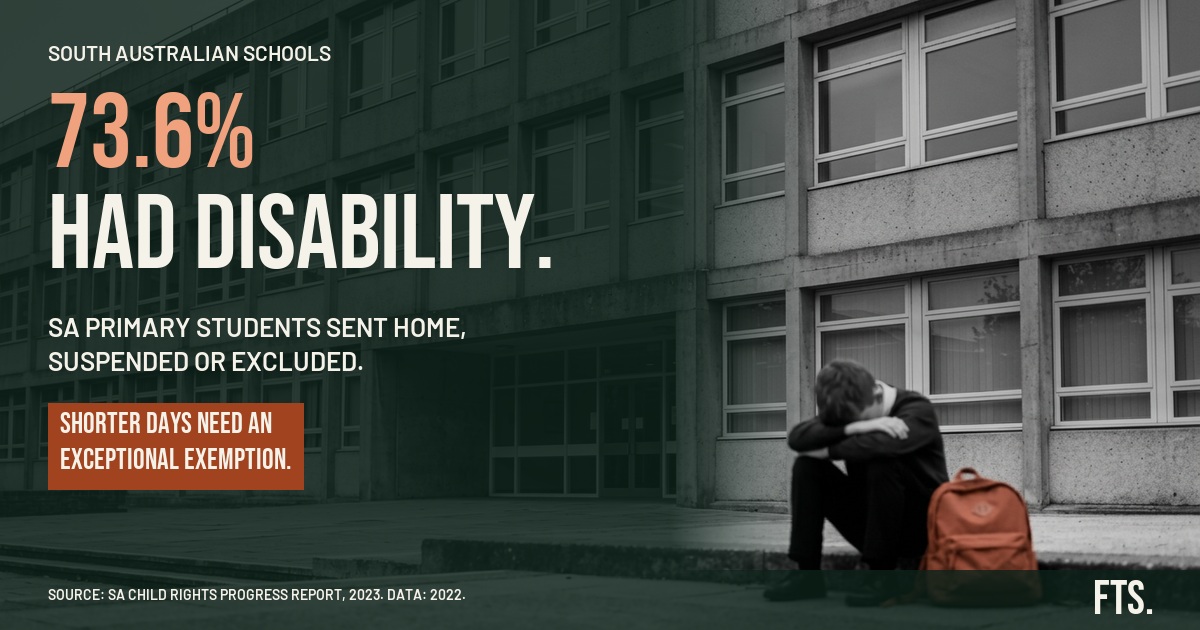
The numbers show who this happens to. In 2022, students with disability made up 33 per cent of enrolments in South Australian government primary schools. They made up 73.6 per cent of the primary students who were sent home, suspended or excluded.[4]
What this shows
Steps 1 to 3 work. The problem starts at step 4.
The same child now sits inside two processes with two different goals. The One Plan is built around the child and changes as the child's needs change. The exemption is built around a return to full time. When the two conflict, the exemption decides.
Families also have to prove their child's disability twice. They have usually already given the school the diagnosis, specialist reports and medical advice so the One Plan could be written. To attend part time, they are asked for evidence again.
Compare this with a child who uses a wheelchair. Their ramp is written into their One Plan, reviewed as they grow, and nobody asks when they will be ready for the stairs. A child whose autism means they can manage two hours a day has a different experience. Their reduced hours are the one adjustment that cannot sit in the One Plan. The first child gets an adjustment. The second gets a deadline.
Who pays the price
The conflict between the two processes plays out in school meetings. A parent who knows what their child can manage sits across from a teacher or principal whose school is measured against attendance targets. Both care about the child. Neither wrote the rule, and neither can change it.
Why the data doesn't show it
The Department's figures show attendance going up. Attendance tells you whether a child is at school. It doesn't tell you what it cost the family to get them there, or whether it lasted. That is why the Engage step starts with families and teachers instead of with the data.
For parents of neurodivergent children, what we want most from school is social connection: friends, a sense of belonging, and not feeling isolated. If a child gets that from an hour at school every second day, that is a good outcome. At the moment, the system can only treat it as a temporary step on the way to full time.
How we want to fix it
The policy, the One Plan and the exemption process are all in place. We want them to work together for the child.
We are proposing a pilot with South Australian schools, working with the Department for Education, using all three stages of EVA.
Engage. We work with families, students, teachers and school leaders in each pilot school. For each case, we record the family's request in their own words, what the One Plan said, what the exemption required and what happened next. This gives a map of exactly where the path breaks, built from real cases.
Validate. We take the findings back to school leaders, the Office for Autism and the Department. Together, we sort each break by whether it sits in policy, process, everyday practice or culture. The people who can change each one agree on what the problem is.
Adapt. We trial changes that fit within current policy. For example:
- recording part-time attendance as a One Plan adjustment
- reviewing the exemption at the same time as the One Plan, so both are looked at together
- increasing a child's hours when the review shows they are ready, instead of on a fixed date
Then we measure the results: whether children keep up their agreed hours, how often families come back with the same problem, how often informal pick-ups and short days happen, and how much time families and teachers spend on it.
Over the longer term, we want:
- attendance to become one of the adjustments a One Plan can record
- families to provide evidence once
- no requirement that every part-time arrangement ends at full time
Teachers benefit too. A clear plan that everyone has agreed means fewer hard conversations and less time spent going back over the same issues.
Why this matters to us
Our mission at FTS. is to make systems work for the people they exist to serve. Becky works from the outside in, with customers, communities and families. I work from the inside out, with leaders, culture and people.
Episode 2 of our podcast, My Brilliant Burnout, looks at the school system through EVA. It releases on Friday 23 October on Spotify, Apple Podcasts, Amazon Music and YouTube.
We are looking for South Australian schools to partner with us on the pilot. If you are a school leader, a teacher or a parent who wants to be part of this, contact me at karen@fixthesystem.world.
You can read more from our System Broken series on ambulance ramping and homelessness in Adelaide.
Because we fix the system, not the people.
Karen Cocks, FTS.
Notes
- The Advertiser, “Why hundreds of parents are fined, sued over school refusal”, October 2026.
- SA.GOV.AU, Exemption from attending school.
- SA Department for Education, Disability support at school.
- Commissioner for Children and Young People SA, 2023 Child Rights Progress Report: Education. Data for 2022, unvalidated.