
There's a particular kind of burnout that catches high achieving neurodivergent women off guard. Not because we didn't see it coming (we usually do), but because somewhere along the way, we've learned to separate it from the brilliance that came before it. As if the ideas, the speed, the drive to change things are one story, and the crash is a completely different one. The crash arrives with a voice that sounds like our own: "I overdid it again. I should have known better. This is my fault." And with it comes a level of internal persecution that nobody warned us about.
Karen and I didn't set out to build a framework. We set out to stop feeling blindsided by our own burnout. What we found instead was a pattern so consistent, so recognisable, that once we named it, we couldn't unsee it.
Building the framework didn't happen the way people often imagine. There was no single moment of inspiration, no "we fed our thoughts into an AI and it created this brilliant thing." What happened instead was something messier and more interesting. A back and forth between thinking, visualising, noticing, listening, and iterating. Some of that iteration happened with AI. All of it happened because we kept noticing things that didn't quite work and refusing to settle for close enough.
This is the story of how that actually works when neurodivergent thinkers use AI as a thinking partner, not a shortcut.
The voice notes
Karen and I don't work in the same room. Some days we don't even work in the same country. What we had, in the early months of building FTS., was a long, ongoing stream of voice notes. Thoughts worth saying out loud. Neither of us was tracking anything deliberately. But after enough months of it, something started to repeat.
A voice note about a brilliant idea, sent at odd hours because it wouldn't wait. Days later, another one about that idea becoming a real plan. Then one about it going out into the world and meeting resistance. Then, reliably, a voice note that sounded different. Flatter. Further apart from the last one. Describing exhaustion that had arrived faster than either of us expected.
Then a gap. Silence. Then rest.
Then, without fail, a new voice note about a new idea, as if the whole thing had never happened.
It took hearing this back enough times for both of us to say some version of the same thing: this keeps happening, and it keeps happening in the same order.
Step one: the pattern repeats
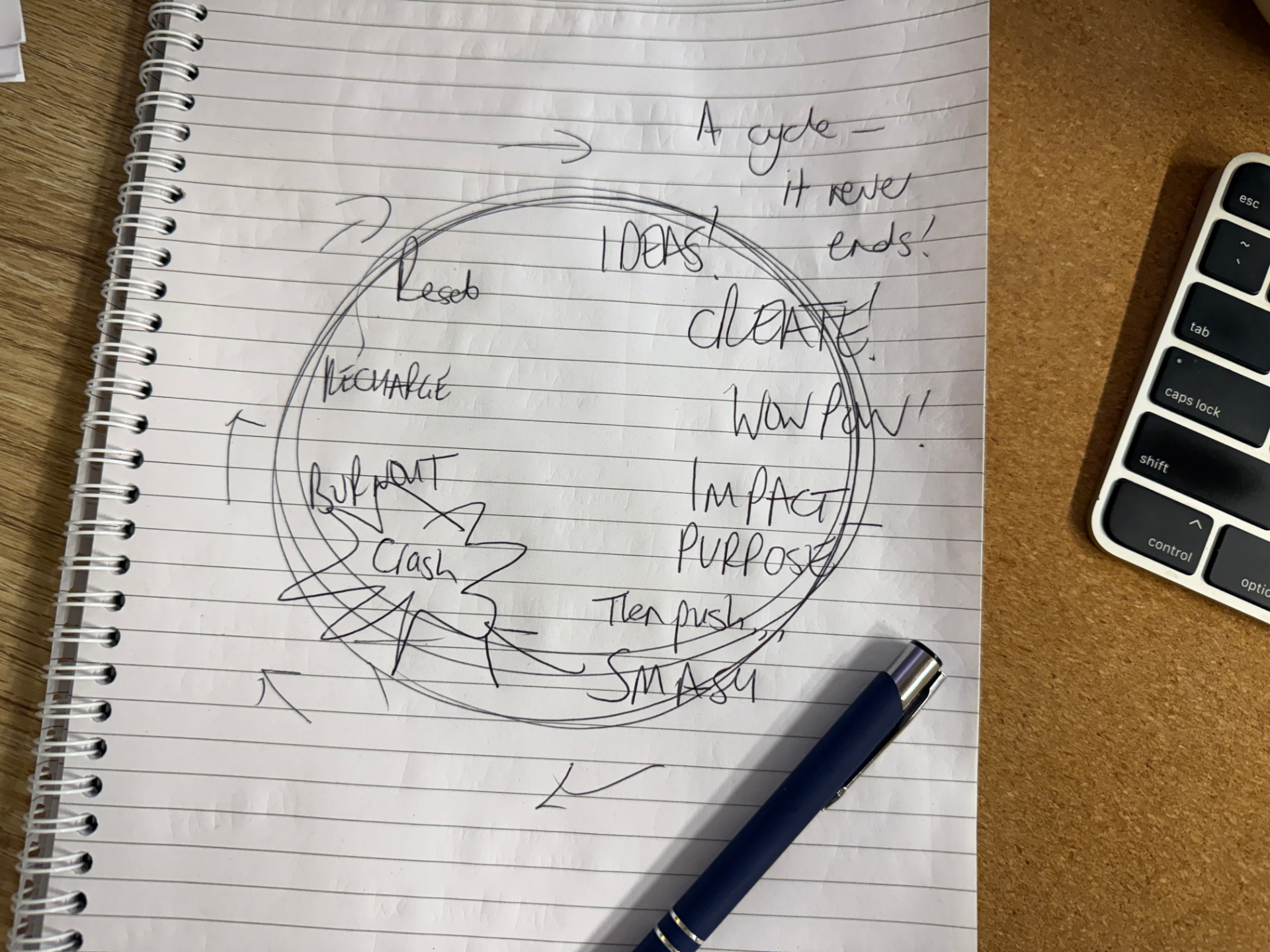
My instinct, once something repeats often enough to name, is to draw it. So I sketched the six moments as a circle rather than a line. Because a line implies an endpoint, and nothing about this ever felt finished.
Ideas, then Create, then Impact, then Push, then Crash, then Reset, then Ideas again.
The shape mattered as much as the labels. A circle doesn't say you're broken for coming back round to the start. A circle says this is the design, not the failure.
That was version one. Rough. On notebook paper. But the pattern was there.
Step two: bringing it to life
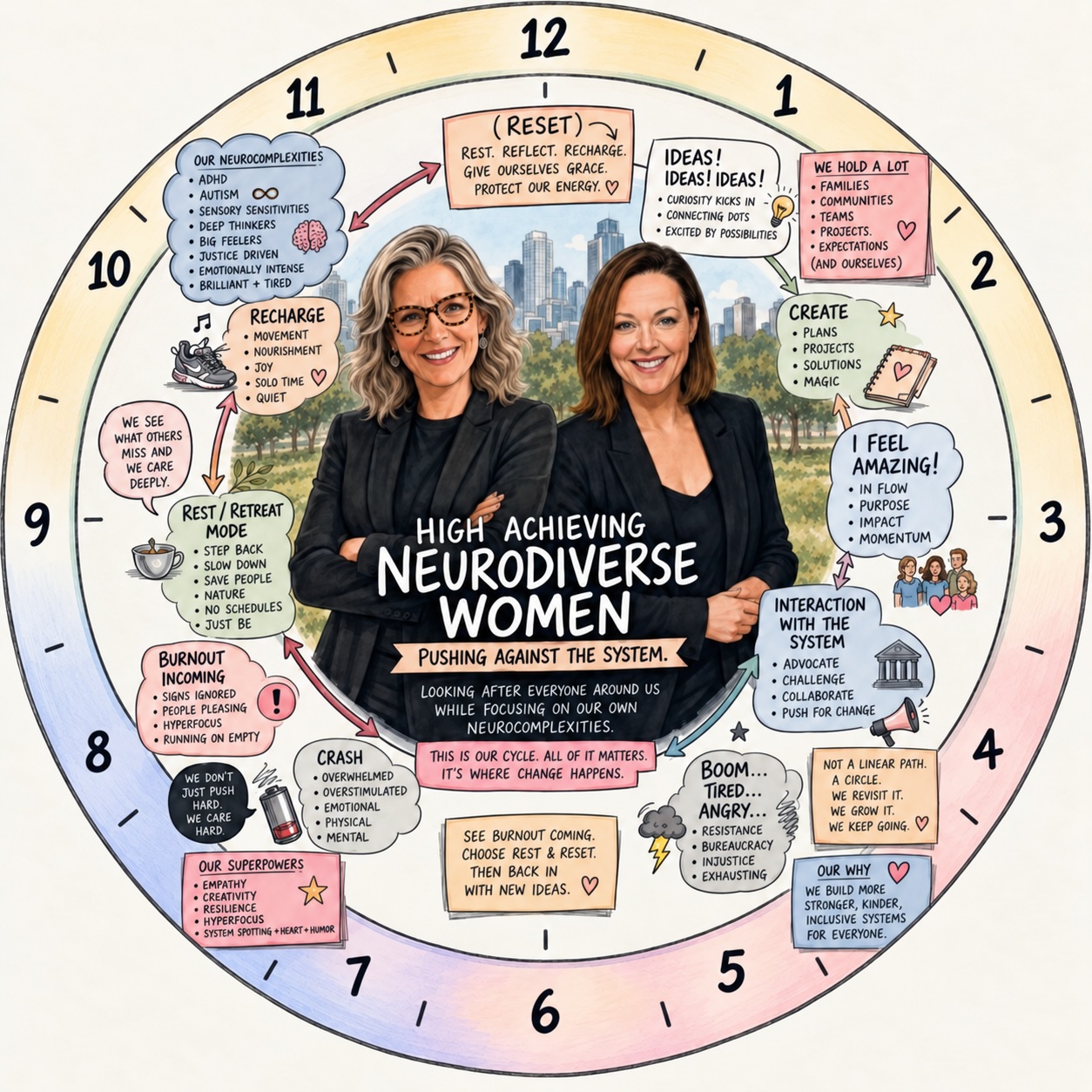
Here's where the thinking got more interesting. I had a rough shape and a clear pattern, but I wanted to see it as Karen and I actually experience it. Not as a clinical diagram, but as the whole lived experience: the observations, the superpowers, the crashes, the neurocomplexities, all of it radiating outward.
So I described what I was seeing to ChatGPT. Not asking it to build the model from scratch, but asking it to help me visualise the thinking I already had.

I loved this. It was comprehensive, it showed the human centre of it, it had all the texture and detail. But something shifted as I started using it.
Step three: natural language revealing a gap
Something interesting happened as I started working with that image. I'd find myself describing where I was in moments of the cycle using clock language without even meaning to.
"I'm at about two o'clock right now, firmly in create and brilliance mode."
"Karen, I'm moving toward four, I can feel the Push coming."
"Right now? I'm at five, eleven. I'm exhausted. Full Crash."
I noticed I kept doing this. Clock positions came naturally to me as a way of being specific about where in the cycle I was sitting, without always reaching for the stage label. It was intuitive. It worked.
So I went back to the thinking: if this is how I naturally describe it to myself and Karen, maybe the framework needs to hold this. Maybe other people do this too. Maybe there's something in having a second symbolic system that lets people locate themselves more intuitively.
It made complete sense to me. So I asked ChatGPT to add a clock face to that beautiful first image. A twelve position analogue sitting underneath the six stages, giving people another language for saying where they were.
And then I sent it to Karen.
Her response was immediate and blunt: it hurts my ears.
Not "it's confusing." Not "I don't like it." It hurts.
I know that sounds strange if you haven't heard it before. But there's real neuroscience behind it. Karen's attention works like monotropism. It pulls tightly into one channel at a time rather than spreading evenly across several running at once. So holding two live symbolic systems simultaneously, translating a label into a clock position and back, costs more cognitive energy than it would for a mind built to run several channels in parallel. And when that processing cost gets high enough, it registers as something closer to physical discomfort.
It's one of those quirks of neurodivergent cognition that seems bizarre until you understand what's actually happening underneath.
Karen was right. When I looked at it again, I realised it wasn't just confusing her. It was confusing me too. It was cluttered. There was too much going on. The layers were competing for attention instead of working together.
It had lost whatever made it work in the first place.
We didn't defend the iteration. We listened. And we went back.
Step four: different thinking, different tools
This is where it got really interesting.
Karen couldn't unsee the problem with the clock version. The visual overload, the competing systems, the cost of holding two things at once. But Karen also held something else in mind. She loves brutalist architecture. It's the entire aesthetic of FTS., actually. There's something about brutalism that speaks to the problem we're trying to solve. Concrete systems that are fixed and rigid and don't want to change. And the people on the outside just trying to work out how the hell to fit into them.
So Karen asked Claude for help. Not to build the framework. Not to generate ideas. But to help her translate what we'd already found into a visual language that was architecturally honest and cognitively accessible.
What came back was this: six words, geometric simplicity, concrete texture. No clock. No competing visual systems. Just stage labels, brutal clarity, and a central space.
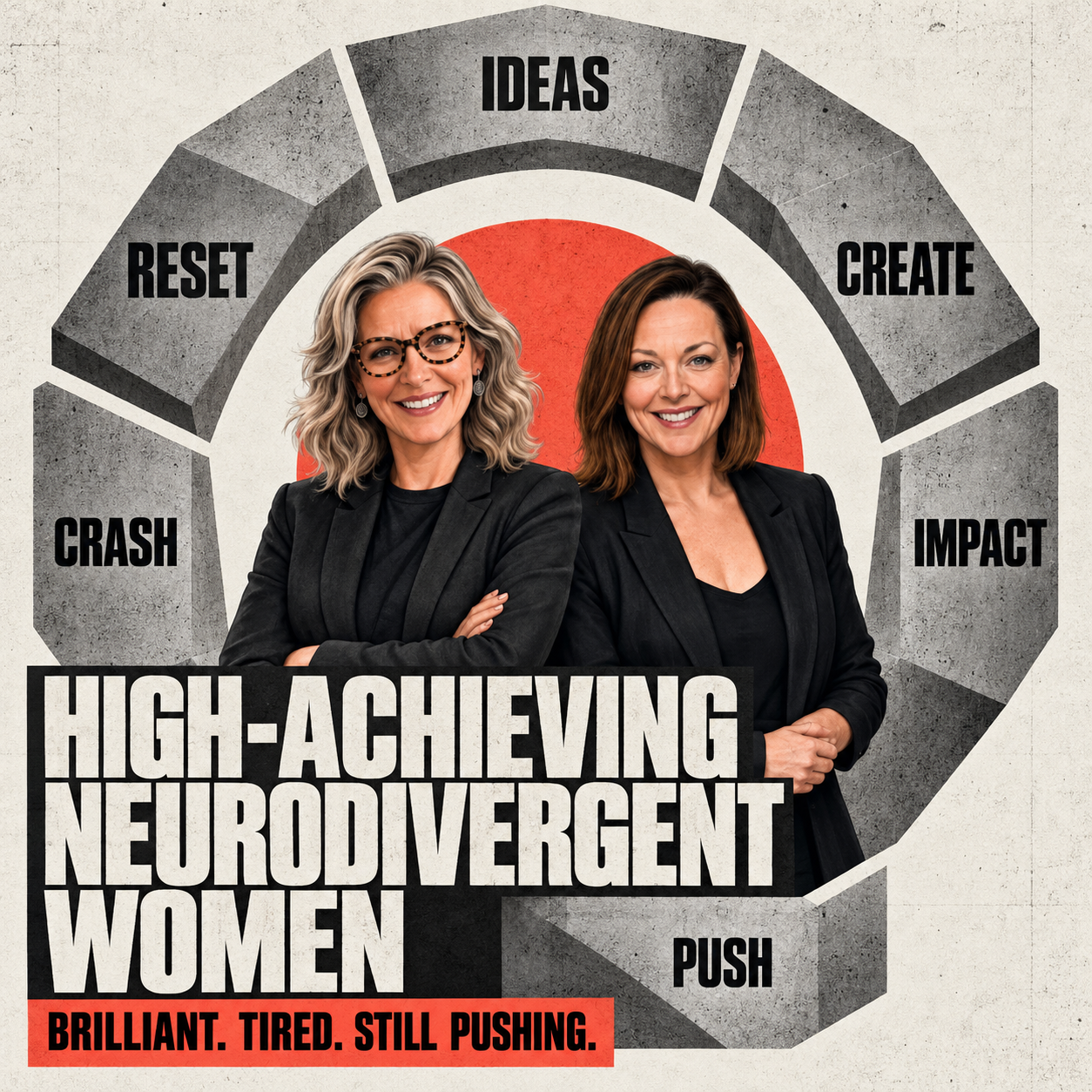
When she sent it to me, I just went: wow. That is phenomenal.
And this time, instead of tweaking it further, I trusted it. But then I realised something else the framework was missing.
Adding the thinking
So I took that brutal foundation and started adding the thinking underneath. What actually happens in each stage? What does the research say about why it works this way? What changes when you stop treating the crash as separate from the brilliance that came before it?
That's when it stopped being a visual and became a framework. That's when I realised we might actually have something here. A pattern that held up against the research, a way of naming something that high achieving neurodivergent women have been living through for years without having language for it.
That became the white paper. The research, the citations, the deep thinking about what this cycle actually is and why it matters, particularly in organisations that want to benefit from the insight and creativity of neurodivergent women.
But the visual stayed at the heart of it. Clean. Brutalist. No noise.
The moment it became real
There was a specific moment when I realised the framework wasn't finished yet.
I'd just come out of a meeting where I'd been doing what I often do: strongly advocating for something at my daughter's school. Fighting a bit. Pushing against a system that wasn't moving the way I needed it to move. And I felt this physical tension in my body. This exhaustion that arrives faster than it should. The friction of being in Impact moving into Push mode, meeting real resistance.

And I realised: this tension needs to be part of the cycle. Not as a failure or a warning sign, but as a stage. Because it's not optional. If you're the person changing things, pushing systems to work better for the people they're supposed to serve, you're going to meet Push. You're going to feel it. It's going to be uncomfortable.
Karen and I started talking about what that stage actually feels like. The bureaucracy. The resistance. The exhaustion of pushing against something that will not move. And that's when the three zone version came into being. The way the cycle breaks down into three distinct experiences: the creative expansion zone, the impact zone, and the recovery zone.
That's the version that's going to be the foundation of our leadership program, Brilliant Leadership. Because once you can name the Push, once you understand that it's not a personal failing but a stage in a predictable cycle, the crash stops being a mystery. It becomes expected. And that changes everything about how you move through it.

What this post actually shows about neurodivergent thinking and AI
Here's what I want to be really clear about, because this matters more than the cycle itself.
This post is an example of something. It's a demonstration of how high functioning neurodivergent humans actually use AI. Not as a shortcut. Not as a replacement for thinking. As a thinking partner.
Look at what happened:
- We noticed a pattern (voice notes repeating).
- We drew it (a circle instead of a line, because the shape mattered philosophically).
- We visualised our thinking (asked ChatGPT to show us what we already understood).
- We used it and noticed a gap (clock language emerging naturally from how I talked).
- We iterated based on that gap (asked to add the clock face).
- We listened to sensory feedback from someone with different neurodivergence (Karen's "it hurts my ears").
- We trusted that feedback and went backward instead of defending the iteration.
- Someone else translated the thinking using a different tool (Karen and Claude on brutalism).
- The research confirmed what we'd already found.
- The thinking deepened.
This isn't what "AI generated content" looks like. This is what neurodivergent pattern recognition, iteration, and refinement looks like with AI as a tool.
Karen and I are massive fans of using AI to support our work. And we're particularly interested in how AI is coming and how many jobs will change as a result. But we think neurodivergent people are actually going to stand out in this landscape. Not because we're unaffected, but because we think differently. We see patterns others miss. We're ruthlessly good at asking the right questions and listening to feedback that doesn't match our first idea.
For us, AI has become an executive functioning support. Finally, we have a colleague who can take the thoughts that won't stop firing in our heads, the patterns we're seeing, the half formed ideas, and help us articulate them. Help us see them. Help us refine them.
We're also occasionally impatient with AI because it's too slow. (Sorry, Claude. But you know it's true.) And that impatience matters. It means we're thinking faster than articulation, and AI is the tool that finally lets us get those thoughts onto something external where we can work with them properly.
This framework didn't come from an algorithm. It came from months of voice notes, from Karen's autistic sensory response to visual clutter, from my realisation that the Push stage needed to be named because I felt it in my body, from research that proved we weren't imagining any of it. AI was part of how we visualised it and refined it. But the thinking? The patterns? The rigorous refusal to settle for close enough?
That was ours. And that's where neurodivergent people are going to thrive with AI. Not by letting algorithms think for us, but by thinking faster and differently than the rest of the world, and using AI to keep up with ourselves.
Step five: deepening the thinking
With the visual finally clear and clean, I could see what we actually had. Karen and I started adding the research, the deeper thinking about why each stage behaves the way it does. That's what became the white paper. The architecture underneath the visual. And as the research grew and we tested the framework more, we realised it needed more layers.
That's when we developed the three zone version: the expansion zone (Ideas and Create), the impact zone (Impact and Push), and the recovery zone (Crash and Reset). This version lets you see not just where you are, but which kind of experience you're in. It holds more nuance. It's the foundation of our leadership program because it gives people and organisations language for understanding what's actually happening at each stage, what's needed, and why the cycle matters as a whole.
But I'm getting ahead. Let me tell you what the six stages actually are.
The model
So here's what we landed on.
Ideas. Curiosity kicks in. The dots start connecting. Possibility takes over.
Create. Plans, projects and solutions come together, often fast. You're in flow. You're making things.
Impact. The work goes out into the world. You're advocating, challenging, collaborating, making change happen. You're doing the thing.
Push. The system pushes back. Bureaucracy. Resistance. Plain unfairness. It's exhausting to keep going. This is the stage almost nobody talks about, because it points at the organisation rather than the individual. But it's crucial to name.
Crash. Overwhelmed. Overstimulated. Running on empty. You saw it coming. You crash anyway. And here's the shift: the crash isn't a malfunction. It's part of the cycle. It's what happens when you've been pushing against immovable objects for too long.
Reset. Rest. Reflect. Recharge. Give yourself grace and protect your energy, on purpose. Not as a luxury. As a necessity.
Then back to Ideas. That's the cycle.
What changes when you name the whole thing
Most support aimed at high achieving neurodivergent women tries to solve one half of this cycle without touching the other. Productivity advice targets Ideas, Create and Impact. Wellbeing advice targets Crash and Reset. Almost nothing addresses Push, because Push is uncomfortable to name. It points at systems rather than individuals.
But here's what actually helps: naming the whole circle out loud, on purpose, before you're standing inside Crash wondering what happened to you.
Knowing Push is coming doesn't make bureaucracy move any faster. But it changes what the crash means when it lands. It stops being evidence that something is wrong with you. It becomes a recognised part of the cycle, arriving in a familiar way, moving through a pattern you can navigate.
The trade offs in this cycle matter, particularly in leadership roles. If organisations want to benefit from the insight, creativity and drive of neurodivergent women, they must also design for what follows sustained Push. That means reducing avoidable resistance where they can. And putting practical mechanisms in place for rest, recovery and Reset where they cannot.
Burnout should never be treated as the price of brilliance. But neither should the conditions that lead to it be ignored while the brilliance is welcomed.
What's next
This framework is the foundation of our new leadership program, Brilliant Leadership. It's designed specifically for neurodivergent women in leadership, and it uses an evolved version of the Perpetual Cycle with additional layers that let you reflect on exactly where you are in the cycle, what you're experiencing there, and what you need.
But before you get there, the framework itself is available as a free white paper. No paywall. Because the pattern we found first in ourselves has to be available to everyone who recognises it in their own lives.
We do not just push hard. We care hard. That includes caring hard about the crash, not just the parts either side of it.
The Perpetual Cycle white paper is available to download free from our library. The full framework, with the three zone version and the tools we use with leadership clients, is part of our Brilliant Leadership program.