

Fix The System · fixthesystem.world
Fix the system, they said. But which one?
By Becky Hirst · 10 October 2026 · 11 min read
Why I'm writing this
Karen and I say "the system" a lot. It's in our tagline: we fix the system, not the people. It's in our voice notes, our podcast, our white papers. It's probably in every second sentence we say to each other.
And recently I realised we don't always mean the same thing by it. Sometimes Karen means the hour and a half it took to get her dog booked in at the vet. Sometimes I mean a nation's entire health service. Sometimes we mean a coffee order, and sometimes we mean legislation.
So I'm writing this partly for you, and partly for me. It's a bit of a cathartic exercise, if I'm honest. I want to pin down exactly what we mean when we say the system needs fixing, because if we can't explain it clearly, we can't expect anyone to trust us to fix it.
Here's where I've landed.
A system is everything that sits between a person and what they need: every step, rule, form, handover, person and assumption along the way.
And systems come in layers, from a single moment at a counter right up to a whole society.
When I posted a video on LinkedIn asking what a system even is, one comment summed up just how wide this gets:
"Whether it's the environment, cost of living pressures, or even dysfunctional family systems there is so much to consider!"
Exactly. Most of us are living inside several systems at once, every single day.
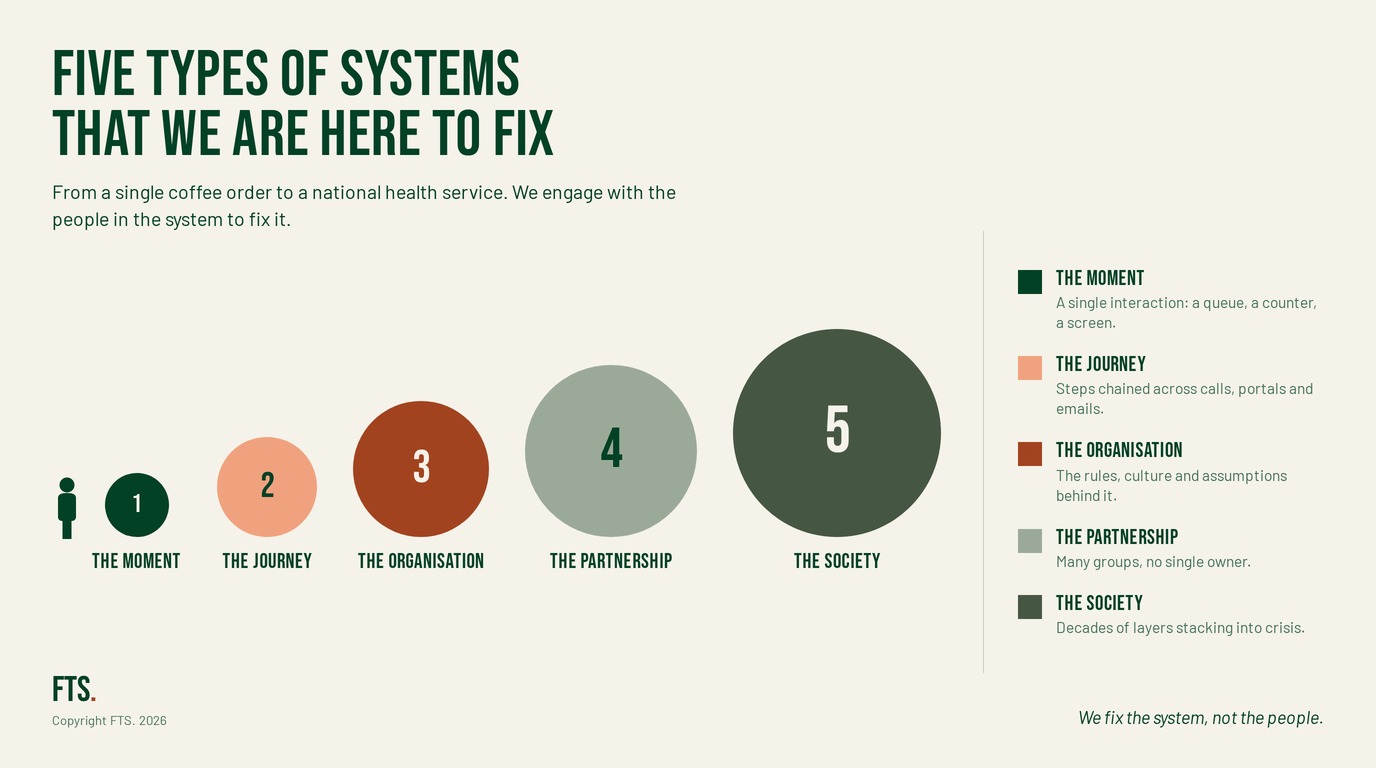
Layer 1: The moment
The smallest system is a single interaction. One person, one counter, one screen, one queue. It's where most of us first notice something is broken, because it's where we feel it.
The coffee order. Picture a café that has added a QR code, an app download, a loyalty sign-up and a separate collection point, all to sell you a flat white. None of those steps is outrageous on its own. Together, they turn a ten-second exchange into a small test of patience. Some people quietly walk out. The café never finds out why its morning numbers are down.
Someone on LinkedIn added a perfect twist on this: order a takeaway online, which saves the business staff time and queues, and you're often charged extra for the privilege.
Airport security. I recently recorded a video about this one while travelling through an airport. Hundreds of people herded through like cattle, unclear instructions, trays everywhere, staff repeating the same thing to every single person. It isn't efficient and it isn't pleasant, for travellers or for the staff absorbing everyone's stress all shift.
What it costs: walkouts, complaints, lost sales and worn-out frontline staff. Small in the moment. Enormous added up.
Layer 2: The journey
Zoom out a little and the moments join up into a journey: a chain of steps across phone calls, portals, emails and appointments, often across days. No single step looks broken. The chain is.
Karen's vet booking. Karen needed to get her dog seen by the vet. It took an hour and a half to follow the process and get a booking. Her video says it better than I can. An hour and a half of a customer's time, and someone on the other end is being paid for every minute of it too.
When Karen shared that video, one comment nailed just how far it reaches:
"It's not just the Vet, it's not just at weekends. It's everywhere, all the time."
Karen's reply says it all: "We are all exhausted from having to learn the process, system or portal before we can access the service."
My carer support appointment. I submitted a web form to a carer support service. An appointment then appeared in my calendar without anyone checking it worked for me, with a note to call a 1800 number if it didn't. I didn't have the time or the headspace to make that call. So they rang at the time that didn't work, twice, left a voicemail, sent a text, and now we're rearranging by email. One meeting, six-plus contacts, and it still hasn't happened.
The systems thinker John Seddon calls this failure demand: work an organisation creates for itself by not getting it right the first time. It's often the biggest hidden cost in a service. (The Portal Toll, our white paper, goes deeper into how customer portals shift this work onto customers.)
What it costs: repeat contacts, missed appointments, rework and staff time spent chasing what should have taken one step.
Layer 3: The organisation
Behind every journey sits an organisation: its rules, its culture, its checklists and its unwritten assumptions about who it's for. This is where good people get stuck following a process they know isn't working.
The patient nobody listened to. A woman goes into hospital with her own health needs, as we all have. She knows her body. She knows what has worked before and what hasn't. But the doctors and nurses are following a checklist and can't deviate from it, so what she knows never makes it into her care. Nobody in that room is a bad person. The system simply has no space for her expertise.
The parent the school didn't hear. A parent sits in a learning plan meeting for their neurodivergent child, with months of observations about what helps and what doesn't. Across the table are teachers who genuinely care, but who are stretched thin and burnt out, with a full class waiting and a template they're required to fill. So there's pressure to keep it brief, and the child comes back reduced to three dot points. The child doesn't fit a nine-to-three box, and nobody in the room has the authority to change the box. And the student, the person it's all about, is rarely in the room at all. I've been that parent, and I don't blame the teachers. They're working within rules the system created, not rules they chose. The plan was built for the institution, not the child, and that frustrates everyone at the table.
The talent that walks out the door. The system isn't only the one customers see. Inside every organisation is another one: how meetings run, how performance is measured, who gets promoted, and the unspoken expectation that everyone works the same hours in the same way. Teams can look like they're functioning on paper while their best people quietly don't fit. They aren't failing. The internal system is failing them. So they leave, and take years of knowledge with them. This is the inside-out lens Karen brings: fix the internal system, and you keep the people who make everything else work.
What it costs: clinical and governance risk, errors, complaints, burnout, disengaged families, and losing your best people, plus the cost of recruiting and training their replacements.
Layer 4: The partnership
Some systems don't belong to any one organisation. They sit between government agencies, councils, community groups, service providers and the public. Nobody owns the whole thing, so nobody can fix it alone. Fixing it means getting all the partners into the same room, often because the law has just changed underneath them.
When partners shape the law. When natural resource management legislation was being overhauled, the partners who would have to live with it were brought in early: boards, agencies, landholders and communities. They informed what needed to change in the legislation, and what they said was acted on. That's what fixing a system at this layer looks like. The people inside it help redesign it, instead of having it land on them. (Read our case studies.)
Child protection reform. When reform becomes law, it has to travel through departments, courts, non-government services, carers and families before it touches a single child's life. Every handover is a place where good intentions can get lost.
As one person who has spent decades advocating within hospital and disability systems put it, this kind of problem needs "a whole picture resolution where collaboration is the key."
What it costs: duplication, reform that lands badly, years of rework, and public money spent on change that doesn't reach the people it was meant for.
Layer 5: The society
At the widest layer, all the others stack up: moments, journeys, organisations and partnerships, layered over decades until a whole state or nation reaches crisis point. By now it can feel too big to touch. It isn't, but it's where the cost of every layer above finally shows up.
Ambulance ramping. Ambulances queue outside emergency departments because there's nowhere inside to hand patients over. Ramping isn't an ambulance problem. It's the visible end of bottlenecks right through the health system: beds, discharge, aged care, primary care. Patients wait, paramedics wait, and the community waits for an ambulance that's stuck in a car park.
When I shared an article about ramping on LinkedIn, someone in my network went straight to a different layer:
"More doctors in residential aged care will reduce the number of older people being sent to hospital via ambulance."
Which is exactly the point. Trying to fix the system by only addressing the ambulances queuing at the doors won't fix the system.
Homelessness. Services for people sleeping rough are planned by bureaucrats, often with real care. But the people on the street were never engaged in designing them, so the services ask for an address, an ID, a phone, an appointment kept on time. The system exists, and the people it's for can't get in the door.
A national health service in crisis, which I've written about in our System Broken series, is the same story at the scale of a whole country.
What it costs: crisis spending instead of prevention, overwhelmed workforces, and budgets poured into services the intended people can't reach.
What connects every layer
Writing this out, the thread is obvious. At every layer, the system was designed from the inside, and nobody asked the people it exists to serve. The café never watched someone order. The hospital checklist never heard from the patient. The homelessness strategy never sat down with someone sleeping rough.
The other thread is where the cause lives. People feel the symptom on the surface - in the moment with what they see in front of them, or how they feel - but the cause is usually a few layers further down. Fix the coffee queue without looking at the organisation behind it, and you've polished the lawn. Systems thinker Donella Meadows made the same point: the deeper the layer you change, the more leverage you get.
That's exactly how our EVA model works:
- Engage on the symptom, at the layer where people feel it, to open up the conversation.
- Validate what we've heard, working down through the layers until we find where the cause actually lives.
- Adapt the system at that layer, so it works for the people it's meant to serve. In other words, fix it.
And yes, it saves money. Absurd is expensive. But the bonus, the bit that keeps us doing this, is that people get what they need without having to fight for it.
Why we can't stop seeing it
Seeing systems in layers like this is just how Karen's brain and mine work. We systemise. We spot patterns. We stand in a queue and can't help mapping every step, every handover and every point where someone is about to give up.
For me, this isn't new. For almost thirty years I've worked with communities across the UK and Australia, and whenever I present, I talk about how I see them: communities of place, of interest, of action and of circumstance, and more. What I've always seen is communities organised in systems. When a community leads itself, I see it running its own system, rather than waiting to be governed or dictated to by a bigger one. It's the intricacies of how communities work that have always inspired and driven me. And when I've worked on government reform, it's often been about connecting all the organisations, partners - internal and external - to deliver whatever is meant to be being delivered. And when I've done internal engagement with leadership, staff and volunteer teams, it's exactly the same: a workplace is a system of its own. Systems are everywhere. So this way of thinking has been there all along. FTS. just gives it a name.
So, which system?
All of them. That's the honest answer I've come to by writing this. When Karen and I say "the system", we might mean a moment, a journey, an organisation, a partnership or a whole society. What we always mean is the same thing underneath: the gap between how something was designed and what the people using it actually need.
Not every problem needs us, and we'll say so. But if you already know something in your organisation has become absurd, and you're ready to find out which layer it really lives in, we'd love to talk.
Someone commented on one of my posts:
"Fixing systems is a bold and ambitious undertaking desperately needed right now, I'd say, everywhere."
We're here, and we're ready.
We fix the system, not the people.
Becky Hirst, FTS.